
Celluvière composes face creams, serums and hair elixirs on a base most houses forgot: grass-fed beef tallow — a lipid matrix of oleic, palmitic and stearic acids that reads like the skin's own surface — refined with cosmetic signal peptides in the Panacea formulation tradition. Moisture, softness, barrier lipids. Nothing more claimed; nothing less given.
Before the era of mineral oil, every apothecary knew what a rendered fat could do for winter skin. Tallow fell out of fashion, not out of merit. We render it slowly from grass-fed suet, filter it to a pale, low-odour lipid, and build on it — because its composition earns the place.
Beef tallow is chiefly triglycerides of oleic acid (~36%), palmitic acid (~25%) and stearic acid (~19%), with smaller shares of palmitoleic and linoleic acids. These same fatty-acid families occur in human skin surface lipids — one reason tallow spreads, absorbs and cushions the way skin's own lipids do.
Composition: Tallow — fatty-acid profile (Wikipedia, USDA data)
In a leave-on formula tallow acts as emollient and occlusive: it softens roughness, slows transepidermal water loss, and gives a cream its dense, lingering finish. That is a cosmetic role — moisture and skin feel — and it is the whole of our claim.
A 2024 PRISMA scoping review (Cureus) examined tallow's biocompatibility with skin: the evidence supports its compositional suitability, and the authors are equally clear that formal cosmetic research is still young. We quote both halves.
Russell MF et al., Cureus 16(6) — Tallow, Rendered Animal Fat, and Its Biocompatibility With Skin: A Scoping Review (PubMed)
The house starts from grass-fed suet, wet-renders at low temperature, and filters until the lipid is pale and near-neutral in scent — a clean canvas that lets the botanicals and peptides carry the fragrance and the character.
Peptides entered cosmetics through a quiet discovery: a small fragment of type I procollagen — the KTTKS sequence — was found to nudge fibroblasts toward matrix production in cell culture (Katayama and co-workers, 1993). Coupled to palmitic acid for skin affinity, it became palmitoyl pentapeptide, the Matrixyl-class signal peptide now standard in serious formulas. Cosmetic peptide reviews (Schagen, 2017; Lintner & Peschard, 2000) describe what such ingredients are for: the appearance of firmness, smoothness and rested skin.
Celluvière's peptide direction is composed with the peptide-design and formulation expertise of Panacea Bio Chem — amino-acid chains are the family trade. Here they serve beauty, in strictly cosmetic measure: leave-on serums and creams that support the look of density and calm.
Cosmetic claims only · no medical promisesFour gestures, one lipid language. The full ritual lives on La Collection.
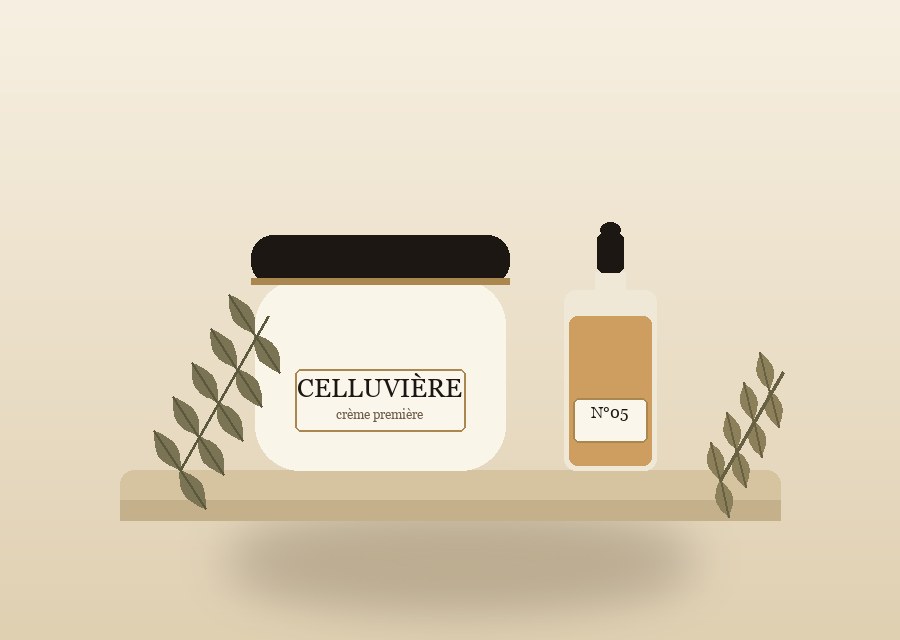
The house face cream: whipped grass-fed tallow, signal-peptide complex, cold-pressed botanicals. A 50 ml jar for morning and evening.
A face serum in a lighter tallow-and-ester base — the peptide-forward gesture, pressed into damp skin before the cream.
The intensive lipid body treatment: unhurried, occlusive, made for elbows, hands and winter.
The targeted concentrate of the line — a dense balm-serum for zones that ask for more.
The hair elixir: tallow-derived lipids lightened with botanical oils, for lengths, ends and scalp massage.
Serum, then cream; balm where the skin asks; the hair elixir on towel-dried lengths. Slow, warm, repeatable.
Celluvière is a natural-cosmetics house founded within the Panacea family — the people behind Panacea Bio Chem's peptide and formulation research. The house speaks with its own voice: warm, botanical, unhurried. The science underneath is the family's own. The fuller telling is on La Maison.
Its dominant fatty acids — oleic, palmitic, stearic — are among those also found in the skin's own surface lipids. In a formula it is a rich emollient and occlusive: softening, slowing water loss, leaving a cushioned feel.
Signal peptides of the palmitoyl pentapeptide (Matrixyl) class are leave-on ingredients used to support the look of firmness and smoothness. Cosmetic ingredients, chosen for appearance — not drugs.
No — animal fats are among the oldest cosmetic bases. A 2024 Cureus scoping review finds the composition compatible with skin use and the formal research still young. We claim cosmetics, not medicine.
A natural-cosmetics house from the Panacea family, with Panacea Bio Chem's peptide expertise behind its formulation direction. More answers on the Questions page.